Recycled EPS Pellets for PS Profile Extrusion: How to Select a Stable Grade
Introduction
For a PS picture-frame profile, decorative moulding or related extrusion product, the pellet is only one part of the formula. Die design, extrusion equipment, additives, cooling, calibration, haul-off and finishing all shape the result. Yet resin variation is often the first place a production line notices trouble: melt pressure drifts, surface quality changes, dimensions move or the foaming response becomes harder to control.
Recycled EPS pellets—reprocessed polystyrene originating from recovered EPS streams—can be a useful material input for suitable profile-extrusion programmes. Their value depends on disciplined feedstock selection and processing. A buyer should not ask only for a “recycled EPS pellet price.” The better question is whether a specific grade has sufficiently controlled flow, moisture, ash, appearance and lot consistency for the profile and line in question.
Cherein supplies recycled PS material solutions for profile applications including picture-frame profiles and decorative mouldings. Its EPS-100 website reference lists MFI 20–25 g/10 min, moisture 0.03% and ash 0.10%. These figures help start a conversation, but the current batch COA, test method and a line trial remain the basis for selection.
Why Profile Extrusion Demands a Different Buying Approach
An injection-moulded part fills a closed cavity; a profile is formed continuously through a die, calibrated, cooled, pulled and cut or finished downstream. Minor material changes can therefore show up as a long run of inconsistent product rather than one defective shot.
Typical outcomes buyers are trying to protect
- Stable melt pressure and output during a production run;
- Smooth, printable or decorative surface appearance;
- Consistent profile dimensions and acceptable straightness;
- Predictable response to foaming agents, fillers, colourants or co-extruded layers;
- Reliable downstream hot stamping, embossing, cutting or assembly;
- Low scrap during start-up, grade changes and repeat orders.
The material decision should connect directly to these outcomes. Procurement, R&D and line operators should align on what “acceptable” means before they compare offers.
Step 1: Identify the Profile and Process Route
Solid, filled or foamed profile?
Tell the supplier whether the product is a solid PS profile, a foamed profile, a co-extruded profile, or a decorative product with a skin/core structure. Each route has different sensitivity to melt strength, flow, additives and surface requirements.
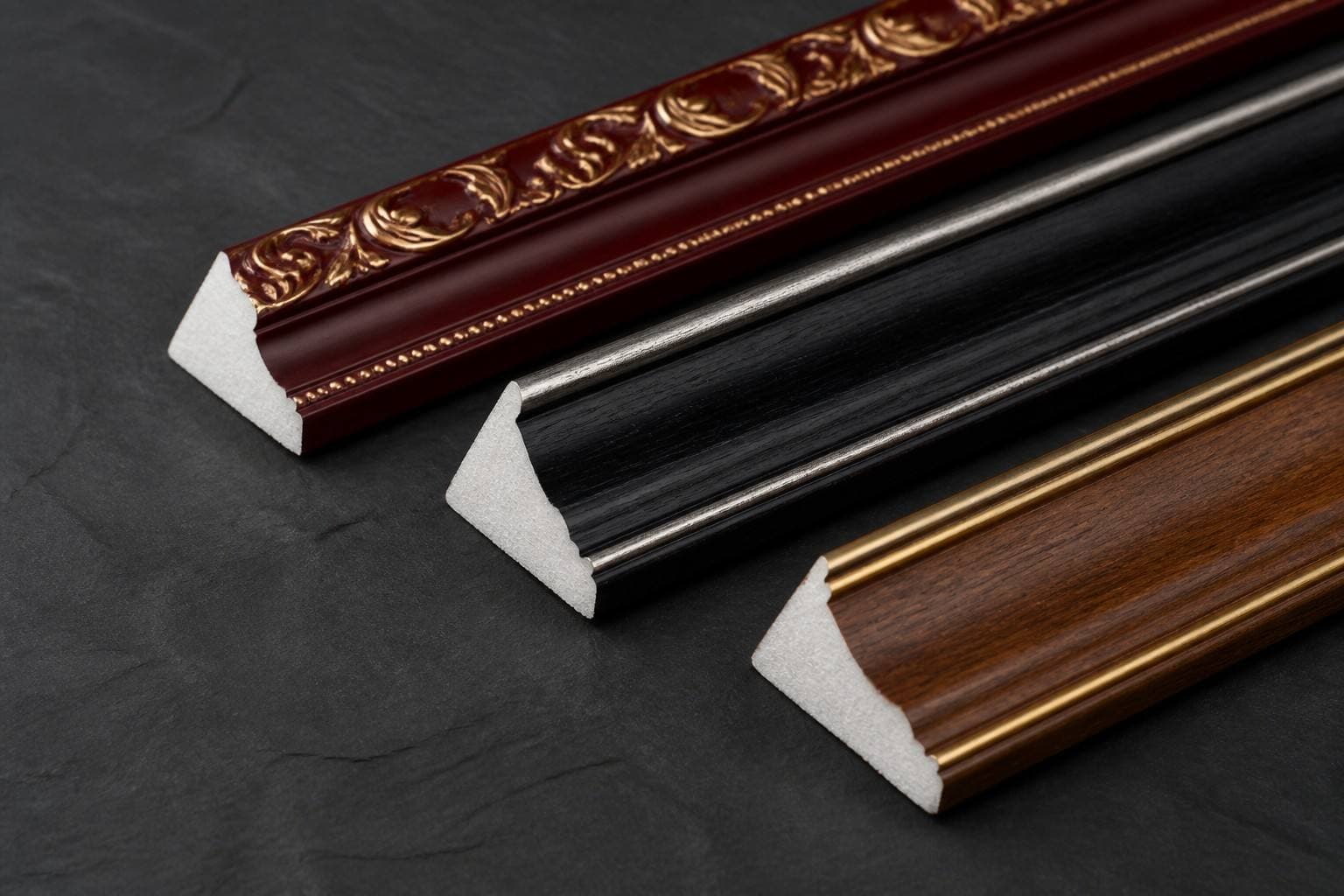
Picture-frame and decorative-moulding producers commonly care about visual finish, corner assembly, hot-stamping response and straightness. A profile used inside a concealed installation may prioritise output stability and dimensional control instead. The same recycled pellet may not be the best fit for both jobs.
Map the current formula before changing the base resin
List the current base resin, recycled content, fillers, processing aids, blowing system where applicable, colour masterbatch and any regrind percentage. If the existing formula works, the aim of a new pellet trial is to preserve the parts of that performance that matter—not to redesign the entire formula unknowingly.
For a new line, share extruder type, screw configuration, approximate output, die type, vacuum/calibration setup and intended post-processing. This installation preparation gives a supplier context to suggest an initial trial grade, while avoiding unsupported promises about final output.
Step 2: Compare the Right Technical Controls
Melt flow: compare like with like
MFI is a useful screening indicator because it reflects how readily the material flows under a stated test condition. However, a number without the test temperature and load is incomplete. Confirm the method used on the COA and compare it with your existing material under the same method.
The EPS-100 website reference of MFI 20–25 g/10 min may suit discussion for selected PS extrusion programmes, but suitability depends on the profile geometry and formulation. A complex thin-wall section and a broad decorative moulding can behave differently on the same machine. Run a trial while recording melt temperature, die pressure, motor load, output rate, profile weight per metre and dimensional data. Those records are far more useful than a pass/fail opinion after ten minutes of production.
Moisture: protect consistency from bag to hopper
Cherein’s EPS-100 reference lists moisture at 0.03%. For a buyer, the important principle is that the delivered material and handling practice should keep moisture and contamination controlled. Store bags in a dry, covered area, keep them sealed until use and make sure conveying equipment is clean. Follow the grade-specific drying recommendation supplied for the current batch if drying is required.
When a trial succeeds but production does not, review storage and feeding before assuming the grade changed. Open bags, wet floors, dusty transfer systems and mixed return material can create variability that looks like a resin problem.
Ash and foreign material: small contaminants can become visible defects
Ash content is one indicator of inorganic residue, but it is not the only cleanliness measure. For decorative profiles, paper, dust, labels, incompatible plastic or metal particles can produce specks, die lines, weak zones or disrupted surface finish. Request current COA data and ask how sorting, cleaning, melt filtration and pelletising are controlled.
Cherein’s described manufacturing route includes sourcing PS feedstock, cleaning and crushing, melting and extrusion, pelletising, packaging and shipment checks. During a supplier review, turn those steps into practical questions: What feedstock streams are accepted? How are labels and metals removed? How is melt filtration managed? How is a lot marked after packaging? Clear answers are more useful than a generic claim of “100% pure.”
Pellet form and feeding behaviour
Uniform pellet size and low fines support predictable feeding. Inspect a representative sample for excessive dust, irregular pieces, obvious colour variation and foreign material. Check whether bag design and palletisation suit your unloading method. These simple details reduce avoidable problems during receiving and changeover.
Colour and surface-finish expectations
If a profile will be wrapped, laminated, printed, painted or hot stamped, describe that step. The base material does not need to look perfect in the bag, but it must process into a surface that the finishing system can accept. A buyer should test the complete route: extrusion, cooling, trimming, decoration, cutting and assembly. Surface quality cannot be judged fully from a pellet sample.
Step 3: Qualify on the Line With a Controlled Trial
Prepare the line before the sample arrives
Use a written preparation checklist:
- Clean hopper, loader, barrel and die according to normal plant procedures;
- Confirm the approved formula and additive batch numbers;
- Prepare measurement points and surface-defect criteria;
- Assign an operator and QC person to record data;
- Keep a retained sample of the incoming pellets;
- Agree in advance what result constitutes a successful trial.
This is not bureaucracy. It prevents a trial from being judged by memory after several variables have changed.
Run the first sample without chasing maximum output
Begin with the established process window for the closest current material. Allow the line to stabilise. Then make controlled changes one at a time, documenting barrel zones, screw speed, pressure, output, cooling setting, haul-off speed and profile measurements.
Inspect for melt fracture, die build-up, roughness, colour streaks, voids, uneven foam structure where relevant, warpage and cut quality. Capture photographs under repeatable light. If the profile requires surface decoration, process enough material to test adhesion and appearance after finishing.
Compare a production-length run
A few metres of profile can look promising while a longer run exposes pressure drift or surface defects. For an important project, run enough material to observe start-up, steady state and a normal downstream operation. Compare scrap, output, profile weight, dimensions and finishing yield with the approved baseline.
The goal is not to prove that a recycled pellet acts exactly like every virgin grade. The goal is to confirm it delivers agreed production and finished-product performance in this formula and process.
Common Problems and the Questions to Ask
Surface roughness or visible specks
First check die cleanliness, screen packs, material handling and contamination from the plant. Then compare retained pellets and review the supplier’s filtration and batch records. If the defect is repeatable, send clearly labelled samples and photos to the supplier rather than only reporting “poor quality.”
Unstable dimensions or profile weight
Review melt pressure, haul-off speed, cooling, calibration and formula changes. Compare actual material flow with the approved lot. Profile extrusion is a system: resin, equipment and downstream settings all interact.
Foaming response differs from expectation
Check the full formulation and blowing-system setup before changing the resin conclusion. Recycled content can influence nucleation and cell structure, but actual response depends on the process route. Treat cell appearance, density and compression behaviour as product-level validation items.
Decoration does not adhere or looks uneven
Test surface energy, cooling condition, moisture/contamination, ink/foil/adhesive settings and substrate appearance. Document the exact production conditions. The material supplier can respond more effectively when the issue is clearly defined.
A Sample Evaluation Table for Your Trial Team
Set up one shared record for every candidate lot. It keeps purchasing, production and quality focused on the same decision rather than on separate impressions.
| Check | Baseline material | Trial lot | Result / action |
|---|---|---|---|
| MFI and test condition | Record current approved value | Record COA value | Confirm comparability before start-up |
| Pellet appearance and fines | Photograph retained baseline sample | Photograph trial sample | Investigate obvious variation before running |
| Start-up scrap | Record kg and defect type | Record kg and defect type | Compare after a stable process is reached |
| Steady-state pressure and output | Record normal operating range | Record observed range | Escalate unexplained drift |
| Profile weight and dimensions | Measure defined points | Use the same points and timing | Compare against drawing/tolerance |
| Surface and decoration | Approved visual reference | Same light and finishing conditions | Retain samples and photos |
| Long-run yield | Good product divided by total output | Same calculation | Include it in cost review |
This table should not be seen as an external certification. It is an internal decision tool that turns a sample run into reusable factory knowledge. Add project-specific items such as corner strength, print adhesion, foam density or assembly fit when they affect the customer’s acceptance.
Prepare for Container-Scale Supply
Once the line trial is approved, the commercial discussion should confirm more than price and lead time. Agree bag material, net weight, pallet pattern, container loading approach, product label content, lot numbering and the documents to accompany the shipment. Ask whether separate lots will be clearly segregated and whether loading photos can be supplied as part of the shipment handover.
At destination, retain an unopened bag from each lot and release production material according to your own incoming inspection rule. This practice is particularly useful when several shifts or multiple extrusion lines consume the same material. It protects traceability without slowing normal operations.
How to Buy for Repeatability, Not Just the First Trial
Put the approval criteria in the purchase specification
An effective purchase specification includes the grade name, test method and agreed range where applicable, colour/appearance requirements, packaging, lot identification, COA requirement, shipping terms and process for non-conforming material. Do not use vague terms such as “premium recycled pellets” as the only requirement.
Approve a lot strategy
For recurring production, define how new lots are reviewed. This could include COA review, receiving inspection, retained samples and a short line confirmation for critical profiles. The exact plan should match the commercial risk. A simple black moulding may need less scrutiny than a decorated export product with a strict customer approval.
Include shipment inspection in the handover
Before export loading, confirm count, labels, packaging integrity and order identity. Photograph pallets and loading where appropriate. At receiving, compare the shipment documents with the purchase order and retain representative material. This closes the gap between a good factory test and a reliable delivered order.
FAQ
Are recycled EPS pellets suitable for picture-frame profile extrusion?
They can be suitable for selected formulations after a line trial. Validate flow, surface finish, dimensional stability, decoration response and assembly performance on the actual profile process.
What specifications should I request?
Request the current TDS and COA, including the stated MFI test condition, moisture, ash or cleanliness indicators where available, pellet appearance, packaging and lot traceability. Compare the values with your approved material and process needs.
Can one recycled EPS pellet grade work for every profile?
No. Profile geometry, formula, foaming route, surface requirement and finishing operation all affect grade selection. Use a specific application brief and trial plan.
How should material be stored before extrusion?
Keep bags sealed, dry, clean and off the floor. Follow the current product documentation for any drying or handling instructions. Avoid mixing material lots without traceability.
Conclusion
Recycled EPS pellets can support stable, commercially useful PS profile extrusion when selection is based on evidence: comparable flow data, cleanliness control, realistic surface expectations and a documented line trial. The right supplier conversation moves from “How cheap is the pellet?” to “Can this grade repeat the results our profile and finishing process require?”
CTA: Discuss your PS profile formula
Send Cherein a photo or drawing of your profile, current material data, formula overview, extrusion route, target finish and monthly volume. We can review the application, provide available recycled EPS grade information and prepare a sample discussion based on your line trial plan.
---